How deloads work and when your body actually needs one
2026-04-28
A deload week is a planned reduction in training load. You cut volume, intensity, or both for about a week, let accumulated fatigue clear, and come back at full capacity.
The counterintuitive part: most people feel stronger after a deload, not weaker. That's because fatigue masks fitness. When you've been pushing hard for weeks, your actual capacity is higher than your recent performance suggests. The deload doesn't make you stronger; it just lets you see how strong you already are.
Why deload weeks exist
You don't get stronger during training. You get stronger during recovery. The adaptation happens between sessions, not in them.
When you train hard consistently, fatigue accumulates faster than it clears. Progressive overload stalls. Your last rep feels harder than it should. Motivation dips. Sleep suffers. None of these are signs you're not working hard enough. Usually they mean the opposite.
When to take a deload
Two approaches work, depending on how well you know your own recovery patterns.
Planned deloads happen on a fixed schedule: every 4 weeks, every 6, every 8. Experienced lifters tend to prefer this because they don't wait until they feel terrible before doing something about it.
Reactive deloads are triggered by something concrete: missing the same weight two sessions in a row, persistent joint soreness that won't clear between sessions, or just feeling run down every time you train. This approach is more practical for most people because fatigue doesn't accumulate on a clean schedule.
What a deload actually looks like
The most common version is cutting volume while keeping the weights the same: same exercises, same intensity, fewer sets. Another option is keeping the sets and cutting intensity, working at around 50 to 60% of normal weight. Either one works. The goal is to stay active without digging the hole deeper.
A full week off is also legitimate, especially after a hard training block, a race, or a competition. A week of nothing doesn't undo months of progress.
How to automate deloads in AddFive
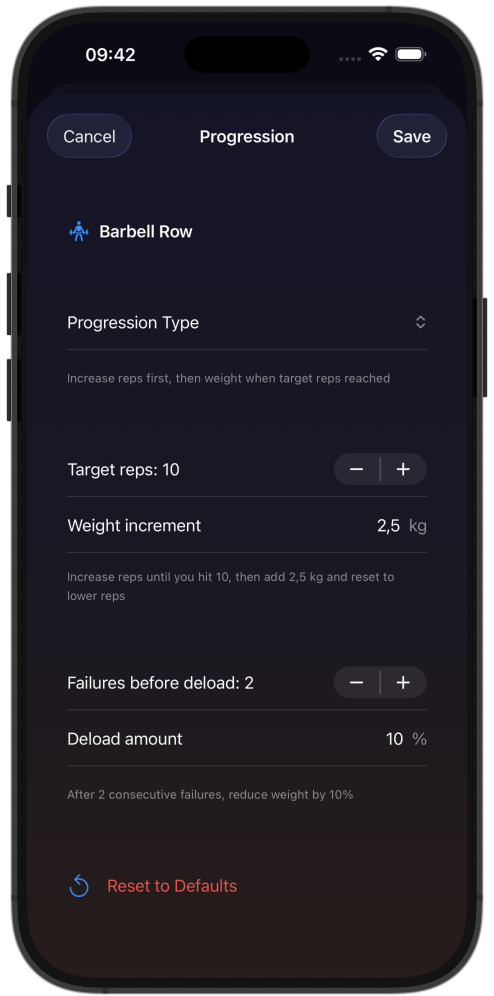
Each exercise can have an auto-deload rule configured alongside its progression rule. You define the trigger (how many consecutive failures) and the response (how much to reduce the weight, as a percentage). When the condition is met, the app applies the deload automatically on the next session. The rule is editable any time from the workout player or exercise settings, same as the progression rule.
For a manual lighter week, the progression confirmation screen that appears after each session is the right place: set the next target lower right there without touching any other settings. Update it again when you're back to full training.
The decision of when to deload manually is still yours. But for the common case of stalling on the same weight, the auto-deload rule handles it without you having to notice and intervene.
---
Related: what is progressive overload explains why recovery is where adaptation actually happens. Linear vs double progression covers the progression methods a deload resets you back into.