Linear vs double progression: which one should you use?
2026-05-05
Linear progression: you add a fixed amount of weight every session. Hit your sets and reps, add 2.5 kg next time, repeat. It's the simplest rule that works, and for compound barbell lifts, it works for a long time.
Double progression: you max out one variable before increasing the next. The classic version is reps then weight: you stay at the same weight until you can hit the top of your rep range, then you add weight and drop back to the bottom. But the same logic applies anywhere you have two variables to work with.
Both are implementations of progressive overload: a clear rule for when to increase the demand. They just do it differently, and one tends to fit better depending on what you're training.
When to use linear progression
Linear works best when the weight increment is small relative to the total load, and when you can add that increment reliably each session or each week.
Compound barbell work fits this well. Going from 100 kg to 102.5 kg on a squat is a 2.5% increase. The body can usually absorb that. Programs like Starting Strength and StrongLifts are built around this: add weight every session until you can't, then adjust.
The problem is when the equipment doesn't support small jumps. You can't add 2.5 kg to a pair of 20 kg dumbbells. Your options are 20 kg or 25 kg, and that's a jump of 25% per side. Linear stops making sense at that point.
When to use double progression
Double progression fits whenever the "next level" isn't a small weight increment.
For machines and dumbbells, that's the most common case: equipment often comes in large jumps, and going straight to the next weight would be too big a step. So you earn the jump by pushing reps first.
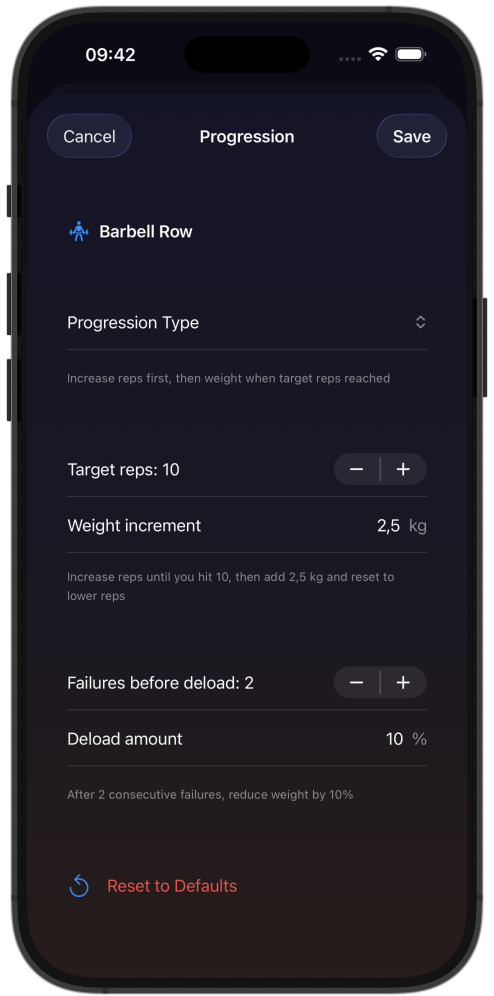
For calisthenics, weight isn't the variable at all, at least not early on. You can't add 2.5 kg to a push-up. Instead, you accumulate reps at the current variation until you hit your target, then you advance to the next, harder variation. The reps drop back down and the cycle starts again. Same principle: max out what you have before moving to the next level.
It's also the standard approach in bodybuilding-style training, where the goal is accumulating volume in a specific rep range (8 to 12 for hypertrophy, for example) rather than chasing a heavy single.
The most common linear vs double progression mistake
Applying linear to exercises where the weight jumps are too big, stalling immediately, and assuming the exercise is just hard to progress. Or applying double progression to barbell work and spending months at the same weight waiting to hit 12 reps when you could have just added 2.5 kg three sessions ago.
The short version: if you can add a small amount of weight reliably, do that. If you can't, use double progression.
In AddFive
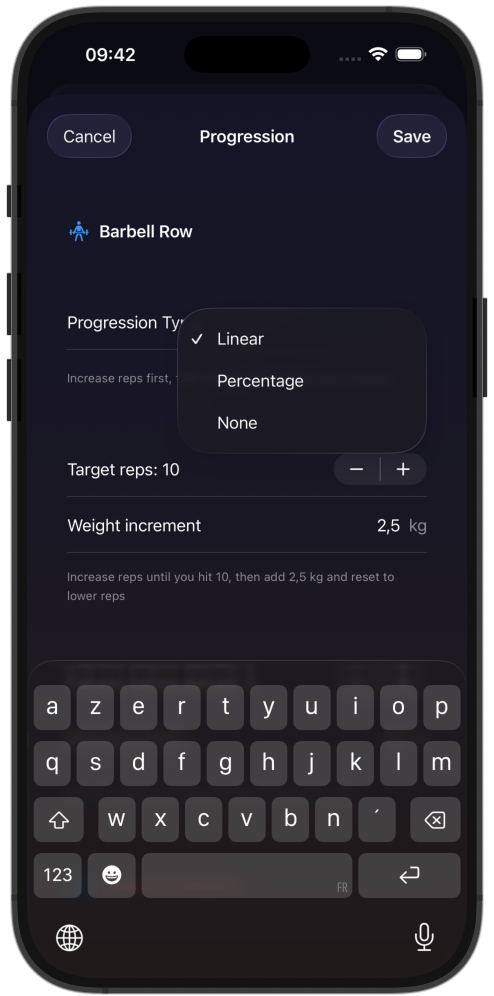
Both algorithms are available per exercise. Linear adds a fixed amount each session (you set the increment). Double lets you define the rep range and what happens when you hit the top: for weighted exercises that's a weight jump; for calisthenics, it's an advance to the next variant in the sequence. You can set these from the exercise settings or inherit them from the program, and adjust from the workout player mid-session if you need to.
---
New to the concept? What is progressive overload covers the underlying principle and how it applies across all disciplines. If your progression stalls on either algorithm, how deloads work explains what to do next.