What is progressive overload (and why most apps only get half of it)
2026-05-12
Progressive overload is the principle that your body only adapts when you give it a reason to. Put it under a load it can handle comfortably and it stays exactly as it is. Push past that, and it rebuilds to handle it better next time.
The practice is simple: keep nudging the demand upward, and your body keeps adapting.
What progressive overload does to your body
When you train hard, you create small tears in muscle fibers. That sounds bad, but it's the whole point. During recovery, your body repairs those fibers slightly thicker and denser than they were before, so the same load feels easier next session.
But muscle fiber repair is only part of what's happening. A large portion of early strength gains, especially in the first weeks and months of training, are neurological. Your nervous system learns to recruit more motor units, fire them in better synchronization, and execute the movement pattern more efficiently. This is why a beginner can add 30 kg to their squat in two months without gaining much muscle at all: the strength is real, but it's coming from the nervous system adapting, not from new tissue.
This neurological adaptation also applies to running. Running economy, how efficiently your body moves at a given pace, improves as your nervous system optimizes the gait pattern. Two runners with the same VO2 max can perform very differently because one has spent more time training the movement itself.
Three things are required for all of this to happen: rest, sleep, and protein. Protein provides the amino acids your body uses to rebuild muscle tissue. Sleep is when most of the actual repair and neurological consolidation occurs: during deep sleep, growth hormone drives tissue repair, and during REM sleep, the brain consolidates the motor patterns practiced during training. Cutting sleep short doesn't just make you tired the next day; it directly slows adaptation. Training hard while sleeping poorly is one of the most reliable ways to stall progress for no obvious reason.
The window between sessions is when adaptation actually occurs. Training creates the signal. Everything else is where the response happens.
Progressive overload isn't just about lifting
Most apps implement progressive overload for one thing: barbells. Add weight to the bar, track your sets and reps, done.
That's fine if all you do is lift. But the same principle applies to every discipline, just with different variables.
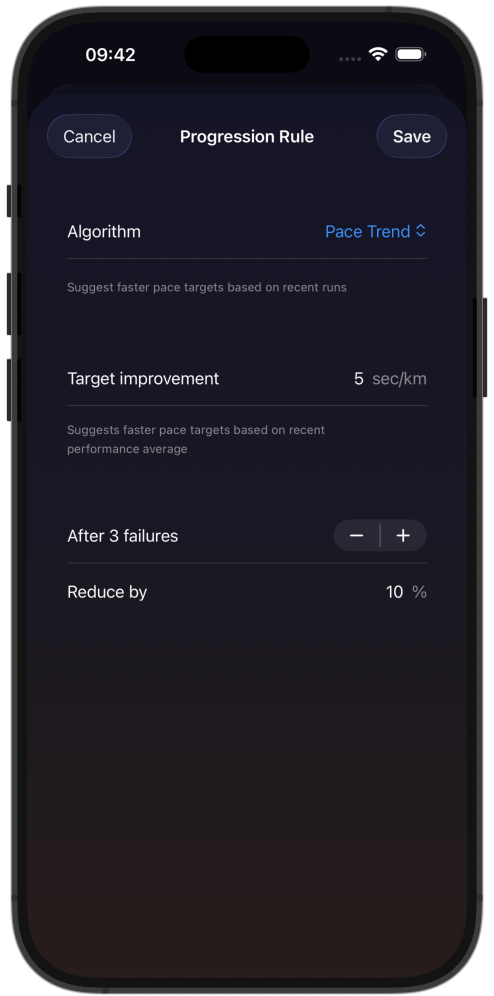
Running and cardio: The load isn't a barbell, it's pace, distance, and intensity. Progressive overload means running a bit faster, a bit further, or both over time. Target a 5:30/km pace when you've been averaging 5:45, hold it for a few weeks, then push again. The cardiovascular system adapts the same way muscle does: your heart gets stronger, stroke volume increases, mitochondrial density grows in the working muscles, and VO2 max improves. These are physical changes to tissue and organ function, not just "getting fitter" in some vague sense. They require the same thing as muscle adaptation: a progressive stimulus and adequate recovery between sessions.
Calisthenics: You can't add weight to a pull-up (well, you can, but not early on). Instead, you progress through variations: from assisted pull-ups to full ones, then to archer pull-ups, then to weighted. Or you increase reps at the same variation until you hit a target, then advance. The progression is real, it's just measured differently.
HIIT: The load is volume and density. Progressing means doing more rounds, or the same rounds with shorter rest, or moving to harder exercises within the same structure. A Tabata that felt brutal in week one should feel manageable in week four if you've been consistent. If it doesn't, something isn't working.
The common thread: there's always a variable you can increase, and always a way to track whether you did.
Why most people fail at progressive overload
The theory is straightforward. The execution requires consistency across months and years, and that's where most people stall, not because they don't understand the concept, but because they can't remember what they did last session.
To decide whether to push harder, you need to know your last pace, your last rep count, your last round total. Most people don't have that when they're in the middle of a session. So they guess, or go by feel, which means some sessions are harder than last time and some aren't. That's not progressive overload. It's just training without a trend.
How to track progressive overload automatically
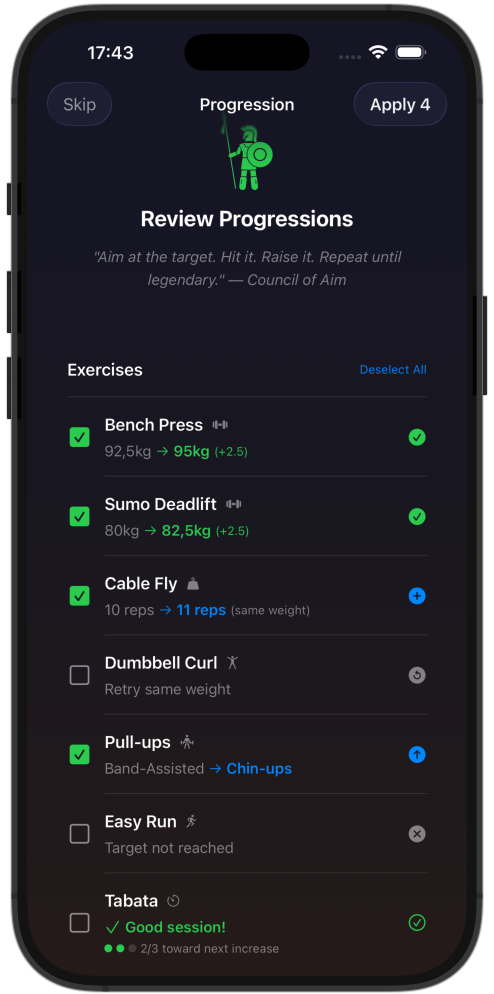
This is the problem AddFive was built to solve, specifically for all disciplines, not just lifting.
Each exercise has a progression rule attached to it, either from the program or configured manually. Linear progression adds a fixed amount each session (2.5 kg, for example). Double progression targets a rep range and bumps the weight once you hit the top of it. Variant progression advances you to a harder bodyweight movement when your numbers are there. Pace trend targets a slightly faster running pace based on your recent average. Round increase adds HIIT rounds once you've been hitting your targets consistently.
After each session, the app applies the rule and tells you the target for next time. You confirm it, adjust if something feels off, and move on.
You can also configure an auto-deload rule per exercise: after a set number of consecutive failures, the app automatically reduces the load by a defined percentage and resets. Like the progression rules, it's predefined but fully editable from the workout player or exercise settings.
If anything feels too aggressive or too slow, you can adjust it on the spot. The rules are yours to set.
The app handles the bookkeeping across all your disciplines. You handle the work.
---
If you want to go deeper on specific progression methods: linear vs double progression covers when to use each. How deloads work covers what to do when progress stalls.